7 minutes read
Making Shopify subscriptions profitable
How to raise subscription profit on Shopify without deeper discounts: unit economics, delivery cadence, bundles, Recharge and Skio portals, and cancel flows.

Most Shopify subscription brands have the same payback problem. Paid acquisition is expensive, subscribe-and-save discounts cut into first-order margin, and too many new subscribers cancel before they ever pay back CAC.
Increasing the first-order discount rarely fixes the issue. Deep upfront offers pull in one-order deal hunters who churn before renewal. At the extreme end of Recharge’s 2026 analysis of 29.8 million new subscriptions, buyers who received 90% off or more paid for a second order 53.4% of the time, compared with 65.0% for full-price buyers.
Across 200+ Shopify stores, Platter works as a Shopify Platinum Partner that models contribution margin by cohort, then implements and tests the changes on Recharge and Skio that raise net profit per subscriber. That work happens across the PDP buy box, delivery cadence, recurring bundles, the customer portal, and the cancel flow. Here is how to audit your cohort economics and fix each one.
How to improve subscription profitability and unit economics on Shopify
Improving subscription unit economics on Shopify starts with auditing cohorts on contribution margin instead of top-line revenue. Multiplying monthly recurring revenue by 12 ignores churn decay. At 7% monthly churn, $1 of starting MRR generates roughly $7.72 over the next 12 months instead of $12, a 36% gap. Static LTV formulas create a similar distortion by dividing revenue by a single blended churn rate, which hides front-loaded drop-off in the first 90 days and inflates 12-month projections.
Profitable programs track all-in customer acquisition cost against the contribution margin per order. Contribution margin accounts for the cost of goods sold, fulfillment, shipping, payment fees, subscription app fees, discounts, and returns. Dividing all-in CAC by contribution margin per order shows how many orders it takes to break even, and pure DTC brands should target a 3 to 6 month payback window on contribution margin (Eightx, July 2026). On a 12-month cohort basis, a healthy contribution-margin LTV to CAC ratio sits between 2.5:1 and 4:1, based on Eightx’s May 2026 benchmarks across 35 DTC brands.
Best strategies to increase subscriber lifetime value
Raising subscriber LTV on Shopify starts with getting buyers past the first two renewals. Recharge’s 2026 renewal-cycle data shows about 61% of voluntary cancellations happen at those first two cycles. The highest-margin fixes start on the storefront with delivery cadence and product page setup, then continue into recurring bundles, the customer portal, and the cancel flow.
Matching delivery cadence to real consumption
Subscribers who end up with more product than they use tend to cancel, and a deeper discount doesn’t fix that. Teams fix this by setting the default delivery frequency from actual consumption rather than forcing every buyer onto a flat 30-day schedule.
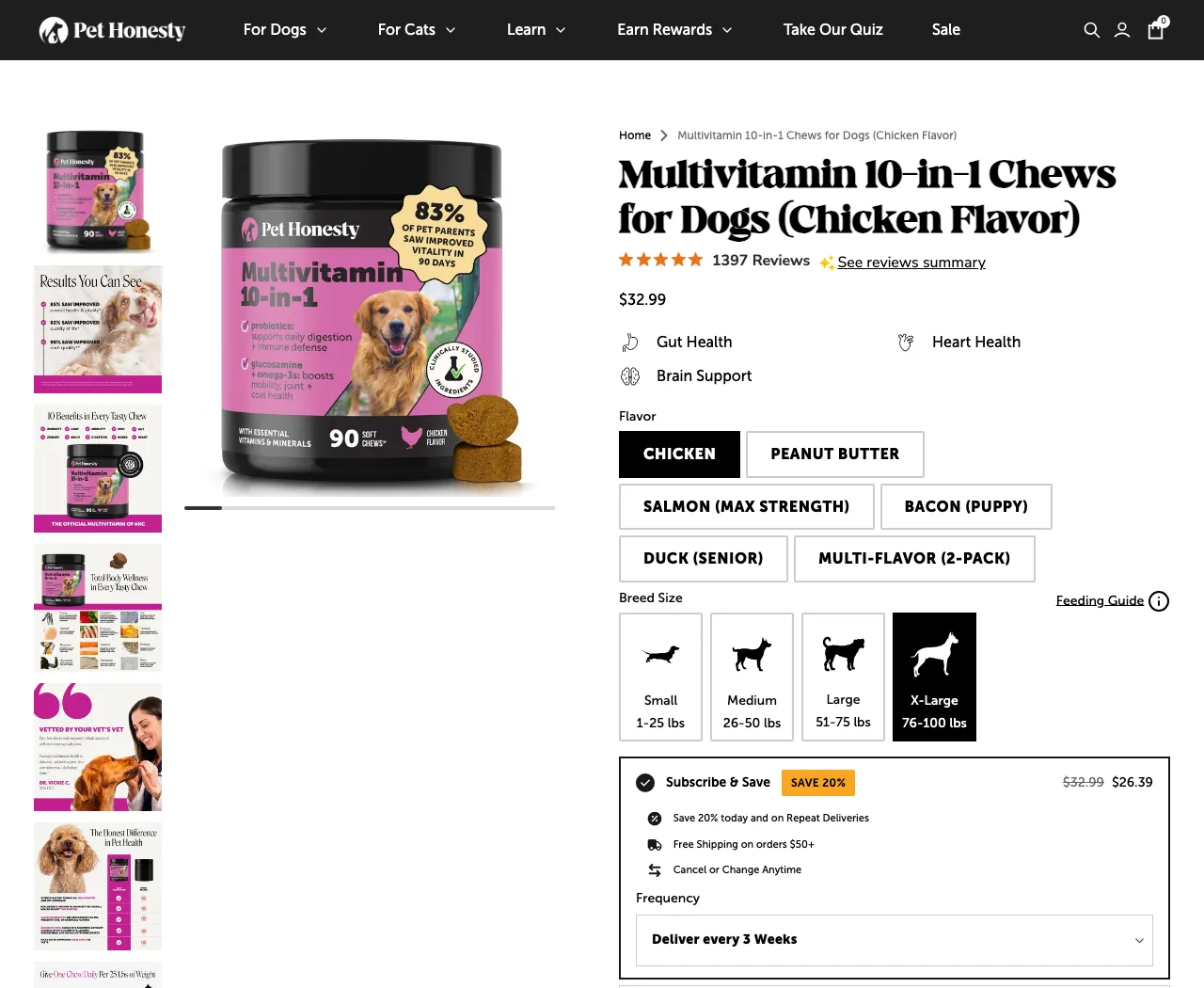
For Pet Honesty, Platter built the buy box around dog size so the subscription delivery frequency updates automatically based on consumption. A 90-chew jar of its Multivitamin 10-in-1 Chews lasts very different stretches depending on breed size, from 1 chew a day for a small dog (1 to 25 lbs) up to 4 chews a day for an extra-large dog (76 to 100 lbs). Tying the default cadence to the size selector stops small-dog owners from stockpiling jars and keeps large-dog owners from running out between shipments.
Structuring subscription options on the product page
The product detail page determines who subscribes and whether they survive the first renewal. Default subscription widgets frequently expose contradictory combinations of supply sizes and shipping frequencies. Product pages must constrain options to valid combinations and show live unit economics.
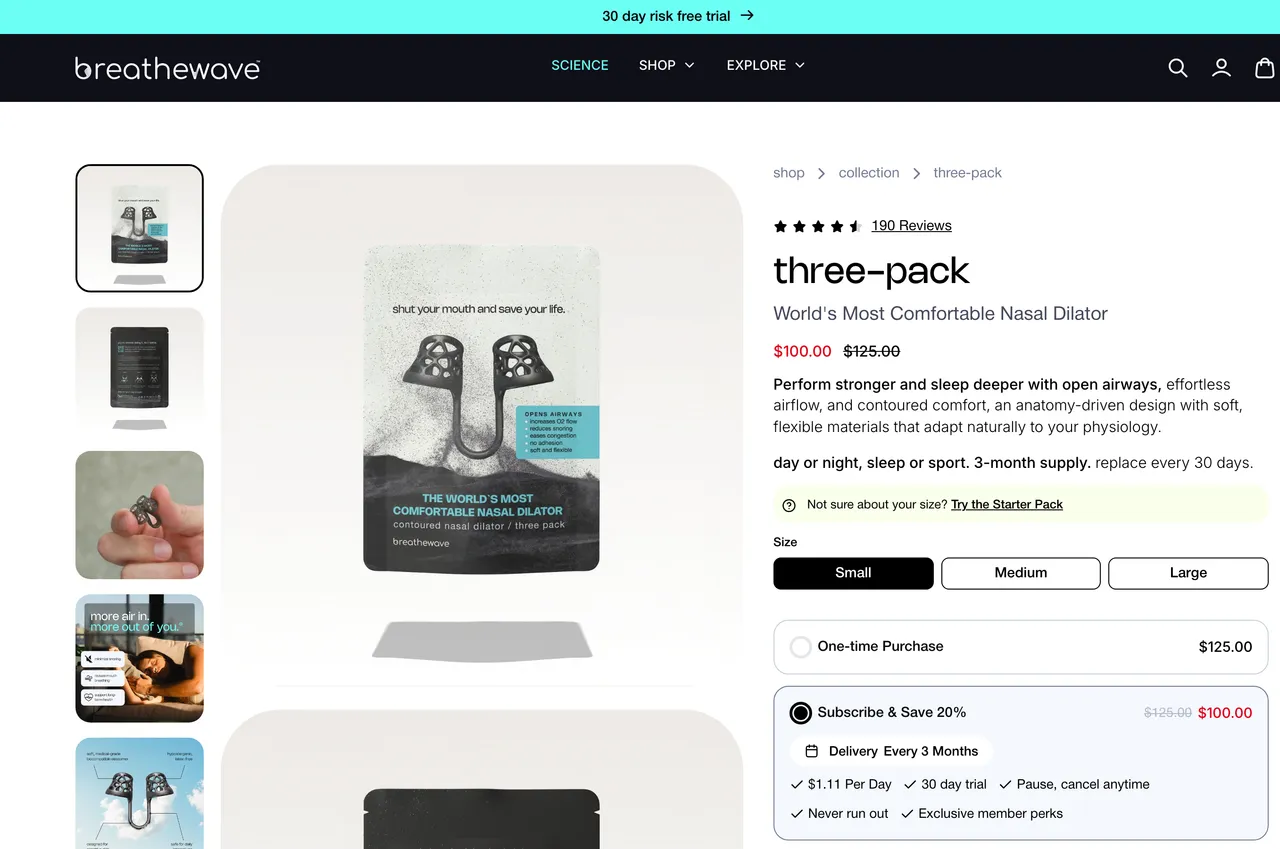
Platter built a custom Skio subscription component for Breathewave that only displays valid options, locks delivery frequency to supply length, and updates price, savings, and cost per day live. The Starter Pack with all three sizes cannot be subscribed to, while the refill can.
Brands testing subscribe-and-save discount depth, front-loaded discounts, or buy-box defaults run these experiments against net profit per visitor rather than conversion alone. Teams can refer to Shopify AB testing: strategies to boost AOV and net profit for exact testing frameworks.
How can subscription brands on Shopify increase order frequency and items per box?
Subscription brands on Shopify increase order frequency and items per box by shifting upsell efforts into the portal and building recurring bundles. Adding one $8 recurring item to a monthly subscription generates $96 more per year with no extra ad spend and no extra shipment.
Grouping complementary items into a recurring build-a-box flow compounds across every renewal. Shopify’s Cart Transform API rejects expand, merge and update operations on cart lines that carry a selling plan (Shopify Dev Docs, 2026-01), so subscription bundles need custom logic. For Good Protein, Platter built a dedicated Build Your Own Bundle page with a gamified widget and threshold discounts powered by Shopify Functions so tiered pricing never breaks subscription logic. After the new store launched, Good Protein’s first-order subscription rate rose 67%. Teams weighing build approaches can read Platter’s breakdown of Shopify bundles: app, built-in tool or custom code.
Checkout is often the worst moment to pitch extra products to a first-time subscriber. High-performing programs present curated one-time add-ons inside the customer portal and in upcoming-charge notifications, where subscribers can try a new flavor or accessory with combined shipping. To raise real order frequency without forcing shorter intervals that cause stockpiling, give fast-consuming households one-tap “Get Now” or “Ship Soon” controls in the portal and pre-renewal SMS so they can pull an order forward whenever they run low.
How to optimize a Recharge or Skio customer portal on Shopify
Treat the customer portal as your primary retention surface rather than a settings menu. In Recurly’s analysis of 76 million subscribers, pause usage rose 337% among top brands that offered pause before cancel, and 3 out of 4 of those subscribers came back within months.
Recharge and Skio offer different native features, though the goal on both platforms is making self-serve edits take seconds on mobile.
| Feature | Recharge | Skio | What to configure |
|---|---|---|---|
| Login | Passwordless login with a four-digit code sent by text or email, plus a Manage Subscriptions link in the Shopify customer account | Passwordless magic login links, plus login through Shopify’s new customer accounts | Put a one-click portal link in every pre-renewal reminder so changes take seconds on mobile |
| Order changes | The Affinity portal lets subscribers send an order now, reschedule, skip, swap and change quantities from one page, and Concierge SMS handles routine changes by text | Customer Portal v3 shows Get now and Skip in the top bar by default, with swap, quantity and add-product actions in the bar, the More menu or the footer | Put skip, delay, swap and get-now above the fold, beside the next charge date and total |
| Add-ons | Subscribers can add one-time products to an upcoming order in the portal, and Concierge SMS suggests add-ons by text | A Smart Upsell carousel offers one-time products for the next order | Feature low-friction add-ons like samples or new flavors that ride in the next box |
| Swaps and bundles | Swaps can be limited to a chosen collection, and bundle contents can be edited in the portal | Product swaps and quantity changes, with Dynamic Build-a-Box for bundles | Pre-map swap rules (flavor to flavor, size to size) so subscribers never see incompatible or out-of-stock items |
How to design a cancellation flow and win-back strategy on Shopify
An effective churn program separates four distinct exit moments and builds a specific response for each: before renewal, at the cancel button, at payment failure, and after cancellation.
Stop offering blanket discounts at every cancel attempt. In Loop’s July 2026 analysis of 441,000+ cancel attempts across 87 DTC brands, a generic blanket discount saved about 6% of cancel attempts, while a structured three-stage flow matching the reason to the offer saved about 15%. When a customer has too much product, route them to a slower cadence. When a customer is tired of a flavor, route them to a one-click product swap. Provide discounts only when price is the stated barrier.
California’s Business and Professions Code § 17602 requires any online save offer to sit next to a visible click-to-cancel button for contracts entered into, amended, or extended on or after July 1, 2025. Under Visa’s Core Rules (Section 7.3.6.3), merchants may never retry Category 1 hard declines and are capped at 20 attempts in 30 days for other decline categories.
Differentiate soft declines from hard declines. Send immediate card-update links for expired cards, and use smart, spaced retries for insufficient funds. For win-back sequences, segment lapsed subscribers by their exit reason, and wait until a customer’s remaining supply is plausibly depleted before leading with new flavors or a fresh cadence.
What are the best Shopify agencies for ongoing subscription optimization?
An ongoing agency makes sense when subscription revenue is a priority but subscribers cancel at the first renewals and default app settings stretch out CAC payback. Look for a team that handles the storefront code, Shopify Functions and the subscription app setup together, and that measures retention and customer lifetime value instead of reaching for bigger discounts.
Platter is a Shopify Platinum Partner that runs monthly programs for subscription brands, whether or not the store is built on Platter’s codebase. The team works inside the Shopify store you already have, building custom LTV and cohort models, then implementing and testing the PDP, bundle, portal, and cancel-flow changes that raise net profit per subscriber.
Create a more profitable store
Get strategies, tactics, and insights from the 200+ Shopify stores we've built, delivered to your inbox every week.
That didn't go through. Check your connection and try again.
Continue reading

How long does a Shopify build take?

Questions to ask a Shopify agency

WooCommerce vs Shopify: when should a growing brand switch?
How long does a Shopify build take?

Questions to ask a Shopify agency
WooCommerce vs Shopify: when should a growing brand switch?